
Rue Frochot, since 1946
Published 27 November 2026 · updated 28 November 2026
Dirty Dick has carried its name at 10 rue Frochot since 1946. A restaurant for Americans after the war, an underworld haunt in the 1950s, a hostess bar for decades, a tiki bar since 2013. This is what the archives say.
1938-1945: El Patio, then Chez Hélène
In 1938, 10 rue Frochot still houses a hosiery shop. In spring 1940, it is home to El Patio, "the Franco-Spanish restaurant of Montmartre". At dinner, guitarist Ricardo Garutti and Délia Vasquez, "La Montanesa".
In July 1943, the restaurant changes its name to Chez Hélène. During the Occupation, like many Pigalle venues, it advertises in the German press.
1946: Dirty Dick
On 1 January 1946, Chez Hélène becomes Dirty Dick (company Thorame et Cie). The new name is registered with a typo: “Derty Dick”.
Paris is full of British and American soldiers and tourists. The name most likely comes from Dirty Dick's, a grimy old pub in Bishopsgate, London.
1948-1949: "Dinners, Suppers"
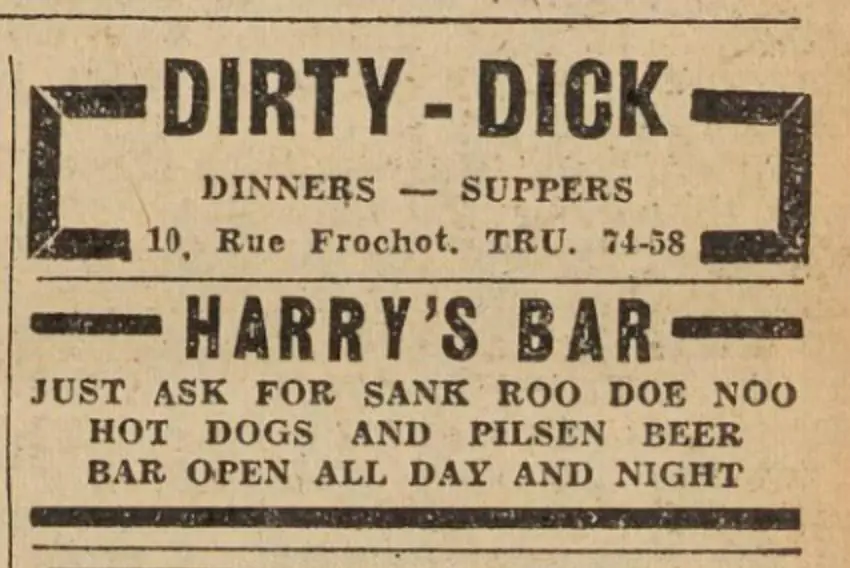
After the war, Americans and Britons flock to Paris. Dirty Dick advertises in the Continental Daily Mail and the New York Herald Tribune, under "Restaurants and Bars", between Harry's Bar and La Coupole: "DIRTY-DICK, Dinners, Suppers, 10, Rue Frochot".
In November 1949, René Fallet publishes Pigalle, a noir novel set in Pigalle. The narrator walks around the neighbourhood. He goes down rue Frochot and lists its bars: "Le Shanghaï, Le Fétiche, Venise, Le Joyau, Dirty Dick Bar, Le Silva, Le Sully". He then reaches place Pigalle and describes this little world you never leave, made of drink, dancing and love. The book is one of the three early novels that won Fallet the Prix du roman populiste in 1950.
1950: Sugar Ray Robinson and the bar's doorman
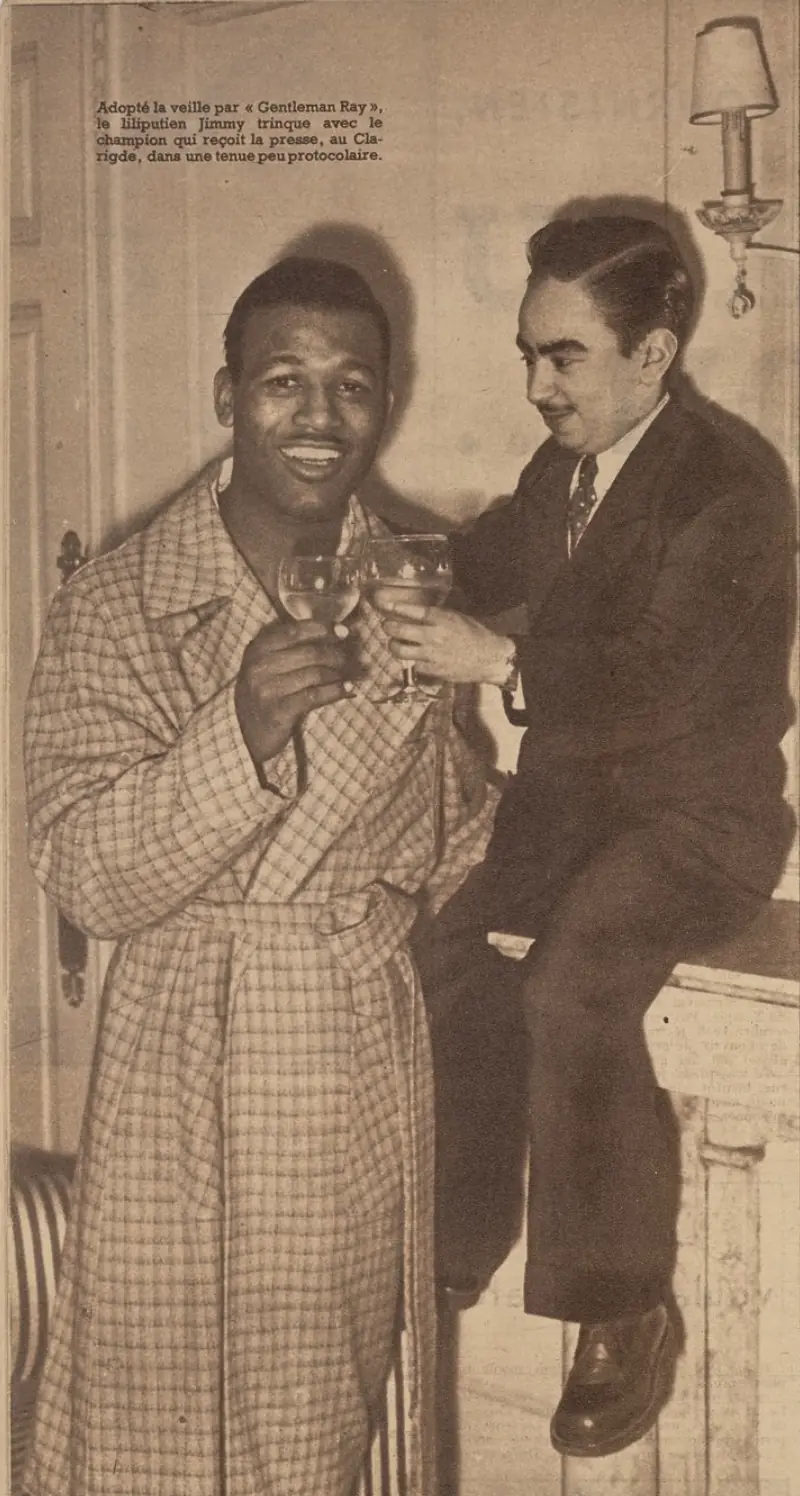
Sugar Ray Robinson is a professional American boxer who fought from the 1940s to the 1960s. He is often named among the greatest fighters in history. He entered the International Boxing Hall of Fame when it was founded, in 1990. In November 1950, world welterweight champion, he arrives in Paris for a European tour.
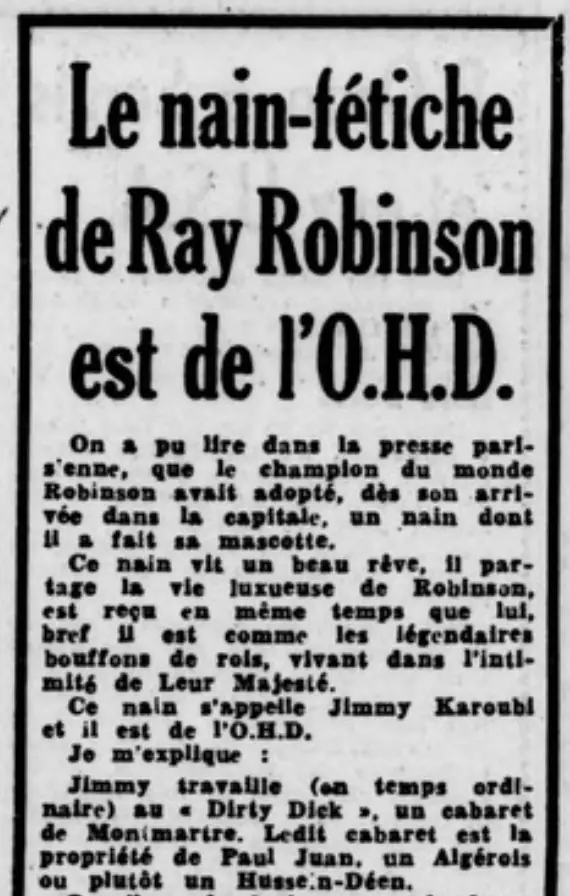
At the time, Dirty Dick belongs to Paul Juan, a man from Hussein-Dey in Algiers, mad about his neighbourhood football club (the O.H.D., an Algerian football club based in Hussein-Dey from 1913 to 1962). His doorman is called Jimmy Karoubi. He is very short, a former acrobat, and he speaks English. Robinson drops by the bar, Karoubi makes him laugh, and the champion takes him along. Karoubi becomes his mascot, his interpreter and his "bodyguard" for the whole tour, before going into films.
"Dirty Dick has lost its doorman," writes La Dépêche quotidienne d'Algérie on 28 November 1950.
1954-1956: the racket war
Paul Juan runs Dirty Dick and the Grand Jeu. His brother Robert runs the Charivari, on rue Godot-de-Mauroy. In 1954, young Corsican racketeers go after the Juan clan. Customers stay away.
On the night of 29 to 30 July 1954, Pierre Cuccuru, known as "Pierre Cuc", a Montmartre gangster, threatens Robert Juan at the Charivari. Juan shoots him dead. Paul Juan tells the police the two brothers have been racketeered for six months. The trial takes place in June 1956. Robert Juan is later shot in revenge. Historian Louis Chevalier tells the story in Les ruines de Subure (1985).
1957: Alain Delon's first film
Yves Allégret shoots Quand la femme s'en mêle (Send a Woman When the Devil Fails), a gangster film starring Edwige Feuillère, Bernard Blier and Jean Servais. A 22-year-old actor plays his very first screen role: Alain Delon, as a hitman. Bruno Cremer also appears, in one of his first roles. The Dirty Dick facade appears on screen, with its "Dirty-Dick" sign in gothic letters.
1960-2012: the hostess bar
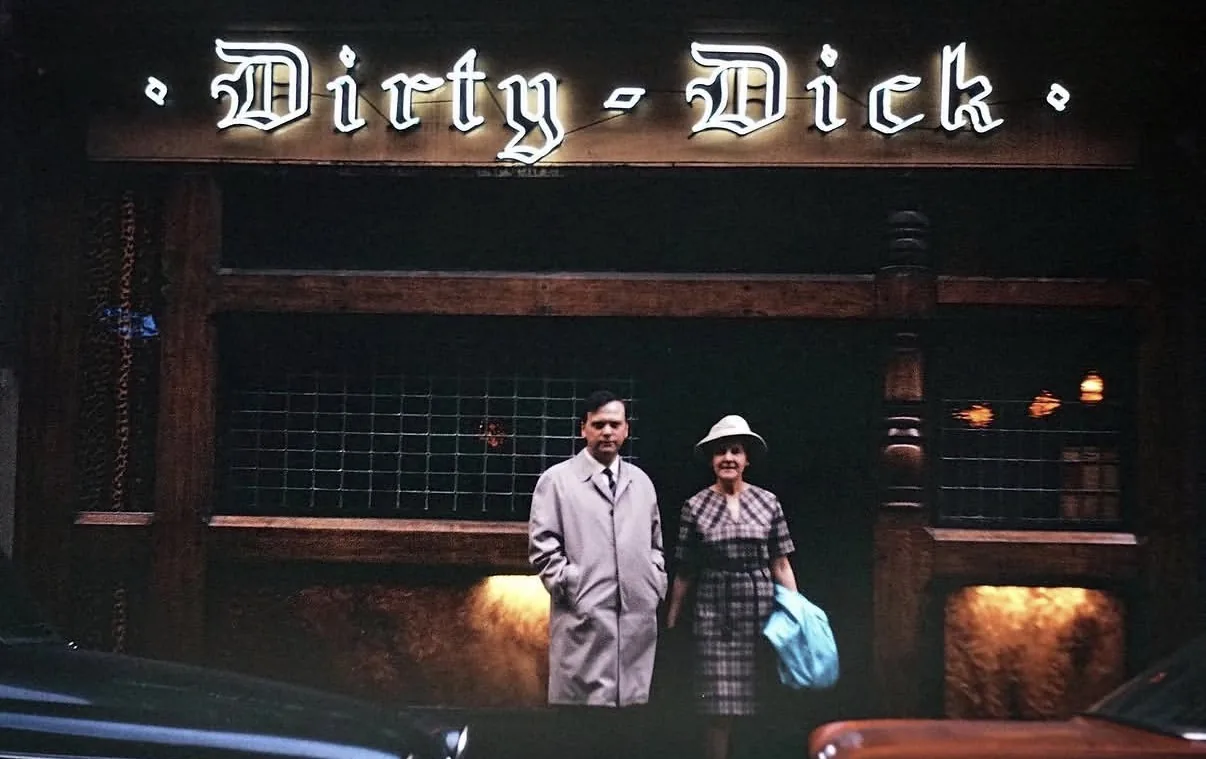
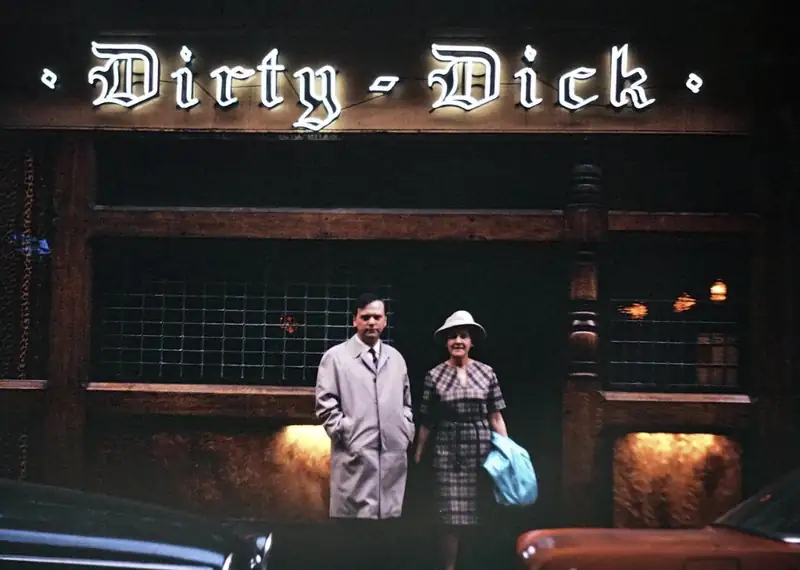
In the 1960s photo, the facade already carries the name in gothic neon letters. Wood panels, cathedral glass, dim light. Dirty Dick becomes one of the hostess bars of rue Frochot. The same company keeps running it, then leases out the business from the 1990s.
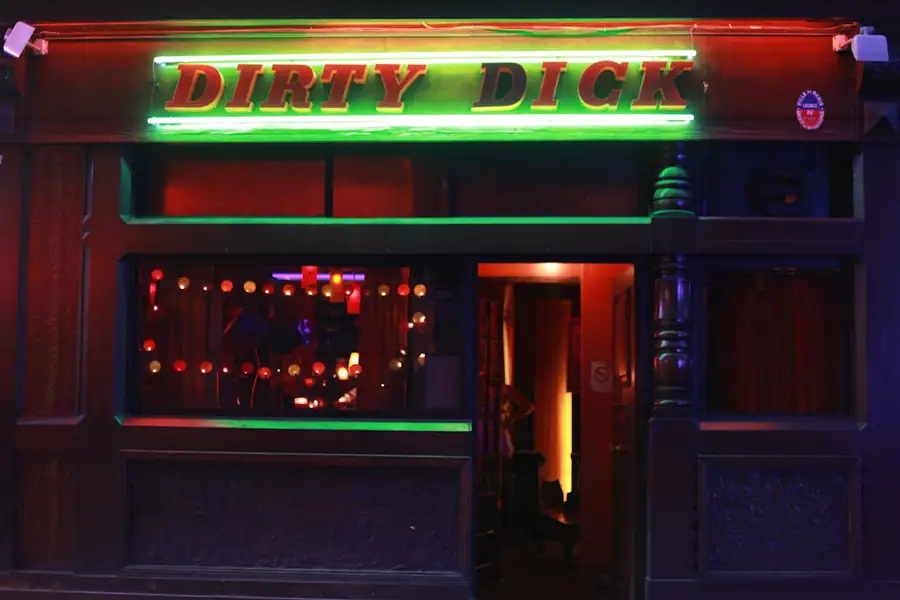
A few traces remain. In 1961, the Actors Cues Directory, a British directory for people in show business, lists Dirty Dick among places to go out in Paris, next to La Tour d'Argent and Lasserre. In 1972, Mankoff's Lusty Europe, an American guide to Europe's "hot" nights, names Dirty Dick's among the bars of rue Frochot. In 1981, in the Italian magazine L'Espresso, a journalist tells how he goes down to Dirty Dick, next door to the office where he works.
This period remains the least documented. If you have memories, photos or documents about Dirty Dick in those years, write to us.
2013: tiki takes over
In 2012, Scott Schuder, a Californian bartender living in Paris and a partner in Liquid Corp, is looking for a place to open a tiki bar. Someone tells him about 10 rue Frochot. He sees the facade and knows this is it. The name stays.
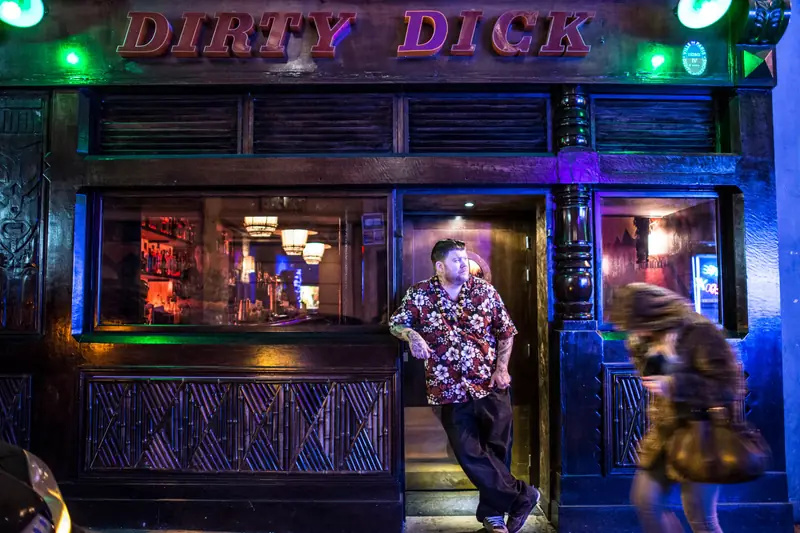
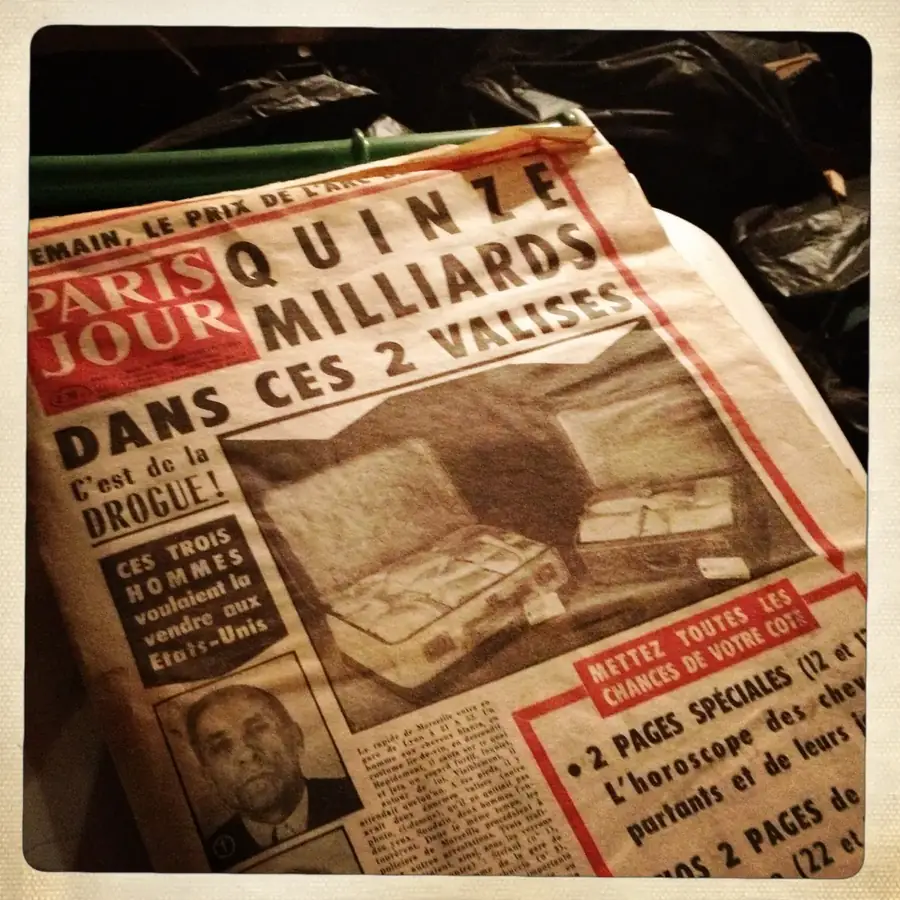
During the works, the team finds a hidden room above the false ceilings, and a suitcase full of old newspapers. On the front page of a 1960s Paris-Jour: "Fifteen billion in these two suitcases. It's drugs!"
Dirty Dick reopens in early 2013. Carved totems, rattan chairs, jungle wallpaper, a sunset pin-up, puffer-fish lamps and a tiger in the smoking room. The story goes on... next stop 2046, Dirty Dick's hundredth birthday.
Sources
- Articles of association of SARL Chez Hélène, deed of 30 July 1943
- Archives commerciales de la France, 8 March 1946 (Chez Hélène company becomes “Derty Dick”)
- Continental Daily Mail and New York Herald Tribune, European editions, October 1948 to June 1949 (Gallica)
- "Le nain-fétiche de Ray Robinson est de l'O.H.D.", La Dépêche quotidienne d'Algérie, 28 November 1950, p. 12
- Détective, no. 233, 18 December 1950
- Le Franc-tireur, 23 August 1954; France-Soir, 24 August 1954 and 13 March 1955; Paris-Presse, 30 September 1954 (Gallica)
- Louis Chevalier, Les ruines de Subure. Montmartre de 1939 aux années 80, Robert Laffont, 1985
- René Fallet, Pigalle, Domat, 1949
- Quand la femme s'en mêle, Yves Allégret, 1957
- Actors Cues Directory, London, 1961
- Mankoff's Lusty Europe, 1972
- L'Espresso, 1981